Market insight
Chinese Heavy Trucks Deepen Their Roots in the African Market
China’s heavy truck exports to Africa have grown rapidly, rising 84.4% year on year in the first four months of 2026. Growth is driven by infrastructure investment, AfCFTA development, and increasing demand from logistics, mining, and construction sectors.
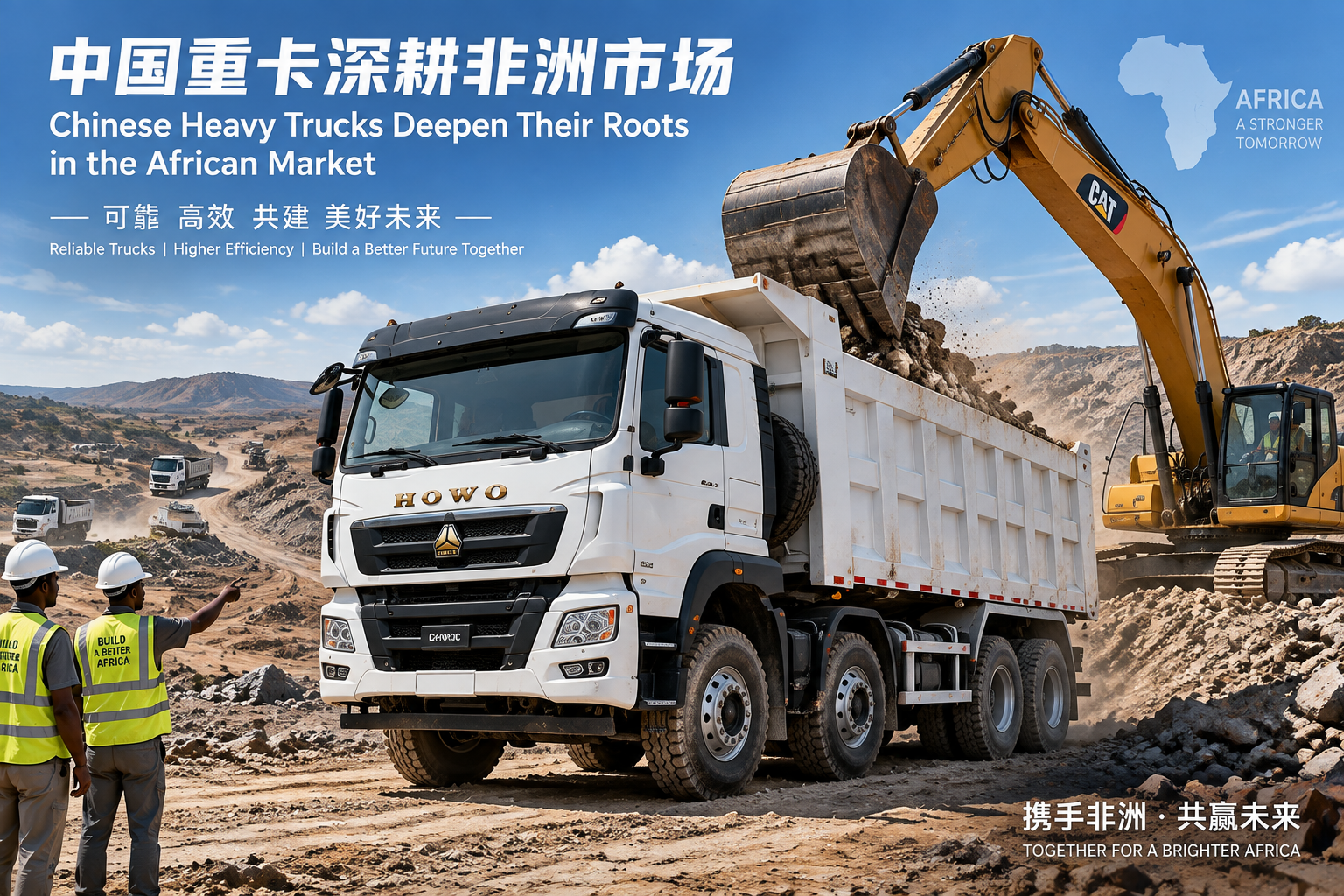
Chinese Heavy Trucks Deepen Their Roots in the African Market
Source: International Business Daily (国际商报), 12 June 2026, 14:13, by reporter Liu Yelin
Africa is currently becoming the fastest-growing market for China's heavy truck exports. In the first four months of the year, the number of heavy trucks China exported to Africa grew by as much as 84.4% year on year, the highest growth rate among all regional markets. Against the backdrop of a reshaping global commercial vehicle export landscape, this leap not only reflects strong demand in the African market but also signals that Chinese heavy truck enterprises are crossing into a new stage—from single-product exports to localised operations and co-building of an ecosystem. As the dividends of China's zero-tariff policy covering 100% of tariff lines for 53 African countries with diplomatic ties continue to be released, Africa is leaping from an incremental market to a strategic high ground for the localised deep cultivation of Chinese heavy truck makers.
**Demand growth, faster exports**
In the first four months of 2026, Africa became an important engine driving the overall growth of China's heavy truck exports.
By country, China's heavy truck exports to many African countries grew by more than 100%. In the first four months, exports to Tanzania grew 1.4 times year on year, to Ghana 2.3 times, and to Kenya 1.3 times.
"The rapid growth of China's heavy truck exports to Africa is no accident; behind it is a resonance of multiple policy mechanisms and market forces," said Liu Yan, a senior expert at the China Automotive Enterprise Internationalisation Development Innovation Alliance and chief lecturer at the China Automotive Strategy and Policy Research Centre of CATARC. In February 2026, the African Union officially launched the Africa Infrastructure Financing Facility (AIFF) to inject capital momentum into the building of the African Continental Free Trade Area (AfCFTA); and from 1 May, China implemented zero tariffs on 100% of tariff lines for 53 African countries with diplomatic relations. These two policies did not directly reduce the tariff cost of Chinese vehicle exports to Africa, but they reshaped the market space for Chinese commercial vehicles in Africa at a deeper level. By accelerating the implementation of AfCFTA, strengthening African countries' capacity to earn foreign exchange, and leveraging large-scale infrastructure investment, they have indirectly cultivated potential demand for commercial vehicles, opening up broader market depth for Chinese heavy truck enterprises.
From the demand side, Africa's commercial vehicle market has long-term growth fundamentals. "At present, road transport is the absolute mainstay of Africa's logistics system, accounting for more than 80% of both passenger and freight transport. However, because the road network is not yet complete, maintenance capacity is limited, and cross-border coordination mechanisms are inadequate, the problems of low transport efficiency and high logistics costs remain prominent. This means that Africa has considerable room for investment in road infrastructure and upgrading in the future, which will in turn drive continued growth in demand for transport equipment," Liu Yan said.
Rising commodity prices have further catalysed demand for heavy trucks in the African market. Africa is richly endowed with mineral resources, and mining occupies an important position in the economies of many countries. Since 2026, prices of commodities such as copper, aluminium, gold and platinum have shown a synchronised upward trend, which is expected to revive mining activity and thus create sustained, rigid demand for heavy trucks in operations such as material transfer within mining areas and short-haul ore transport.
**Multi-dimensional layout, taking root as an ecosystem**
Facing the broad prospects of the African market, Chinese heavy truck enterprises are accelerating their transformation from "products going global" to "taking root as an ecosystem". In West African countries such as Nigeria, a number of domestic vehicle makers—including XCMG Trucks, SINOTRUK, Dongfeng Commercial Vehicles and SAIC Hongyan—have already built KD (knock-down) plants locally, reducing costs and improving response efficiency through localised production, and using these as a fulcrum to expand into the wider West African market.
Liu Yan believes that against the long-term backdrop of continued African economic growth, the heavy truck market has clear room for expansion. Relying on product competitiveness, channel development and the synergies of projects in Africa, Chinese-brand heavy trucks can continue to increase their market share through a number of measures.
Enterprises should seize the opportunities presented by African infrastructure development and free trade area growth. They should deepen "vehicle-cargo linkage" cooperation with AfCFTA member states in areas such as engineering contracting and mineral extraction, and upgrade heavy truck exports from "selling products" to "selling services plus local assembly". At the same time, enterprises should give priority to building KD plants in strategic fulcrum markets such as Nigeria, Kenya and Tanzania to obtain rules-of-origin status and achieve zero-tariff circulation within the region.
In view of African road conditions, hot and dusty climates and heavy loads, enterprises should develop cost-effective customised models—such as reinforced suspension, larger fuel tanks and dust-proof designs—to build brand trust on the strength of quality.
On after-sales service, enterprises should set up regional spare parts centres in major hub cities and promote remote diagnostics technology to shorten repair cycles. In addition, enterprises can join hands with institutions such as Sinosure (China Export and Credit Insurance Corporation) to provide full-lifecycle services such as financial leasing, thereby strengthening customer loyalty and comprehensive service capability.
Enterprises also need to attach importance to new-energy deployment. Using the electric heavy truck demonstration projects carried out in markets such as Mexico as a benchmark, they should promote battery-electric heavy trucks and battery-swapping models for scenarios such as mining, ports and urban logistics, take the lead in forming new-energy commercial vehicle system solutions applicable to multiple African scenarios, and use their first-mover advantage to steer the direction of market application.